The verdict
Is the Croatian folklore show in Zagreb worth it?
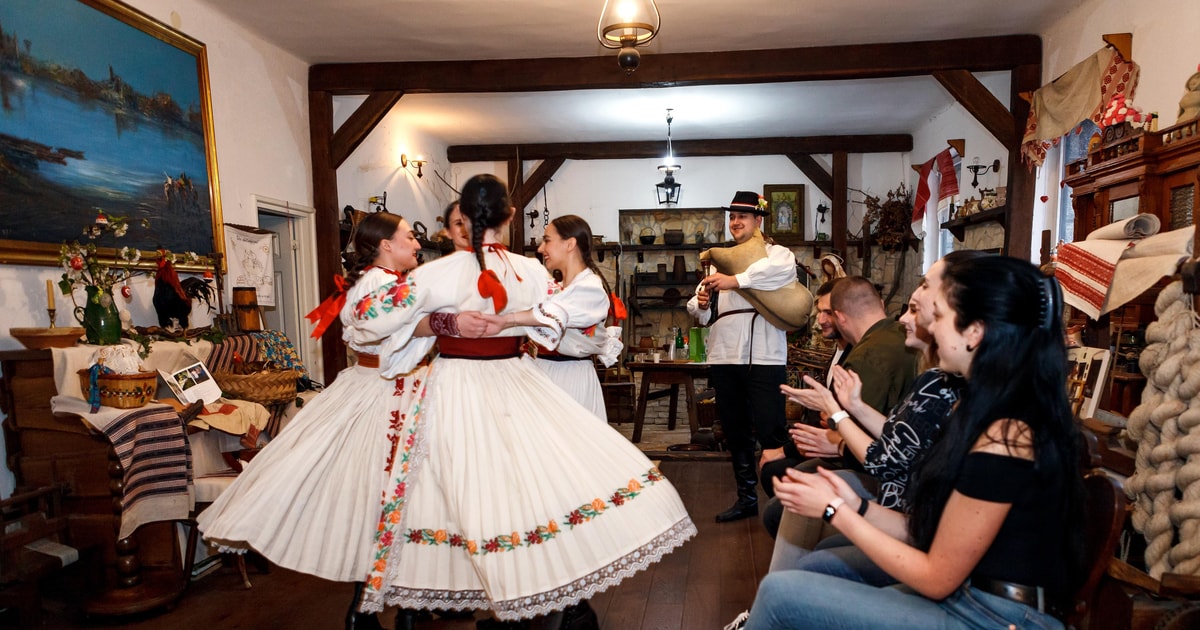
Yes, it is a warm, lively way to meet Croatia in a single hour. Dancers and musicians in folk costume perform dances, songs and stories from across the country's regions, then you tour the venue and raise a glass of homemade rakija. Guests rate it 4.9 out of 5. It is close-up, friendly and easy to follow in English, and it asks nothing of you but curiosity and a way to reach the venue.
Why the hour works
What you will see
A live performance by dancers and musicians in folk costume, with traditional dances, music and storytelling from several of Croatia's regions. Because costume, tune and step change from one region to the next, the hour works like a quick tour of the country without leaving Zagreb.
Then the tour
After the performance you walk through the venue with a guide who talks about Croatian geography, history, cuisine and ethnology. It turns the dancing you have just watched into a story about where the dances, foods and costumes come from.
The rakija and the photos
The evening includes homemade rakija, the fruit brandy found on Croatian tables, and photos with the performers. Both are small touches that make the hour feel hosted rather than watched from a distance.
Reading the rating
Guests give it 4.9 out of 5 across 13 reviews, a bright start for a new listing. The count is small because the show is young, and every voice so far points the same way. Free cancellation leaves you room to reserve without worry.
Fitting it into a Zagreb stay
One hour is easy to place beside a day of sightseeing, and it asks nothing in the way of walking. The calendar lists the dates on offer, and evening places are the ones that fill first.
Seven threads behind the dancing
Seven threads in Croatia's folk tradition
Behind the dancers stand a circle dance, a silent kolo, a plucked lute, a comic song form, regional dress, lace and a fruit brandy. Each note condenses reference articles, and none describes the programme on your own night.
-
The circle
The kolo, a dance for a ring of friends
Wikipedia describes the kolo as a South Slavic circle dance found in Bosnia and Herzegovina, Croatia and Serbia. At least three people take part, and up to several dozen. Dancers hold hands or waists and form a circle, a chain or parallel lines. There is almost no movement above the waist, the basic steps are easy to learn and each region has at least one kolo of its own.
-
The silence
A dance performed without music
The nijemo kolo, or silent circle dance, comes from the Dalmatian hinterland. Wikipedia describes a closed circle in which men lead their female partners in quick, vigorous steps, entirely without music. It is still danced by village groups at festivals, fairs, church celebrations and weddings, and it was inscribed on UNESCO's lists in 2011.
-
The strings
The tamburica, Croatia's national string instrument
Tamburica is a family of plucked, long-necked lutes, often with paired strings. Wikipedia calls it the national string instrument of Croatia and says its modern shapes were worked out in Serbia and Croatia late in the 1800s. The oldest authenticated tambura still known dates from 1847 and sits in a museum in Osijek, in the heartland of Slavonian music.
-
The wit
The bećarac, a song built on teasing
Wikipedia describes the bećarac as a humorous folk song from rural Slavonia, in strict couplets of ten syllables sung to the same tune, usually played by a tamburica band. The lyrics tease, are often improvised on the spot, and rely on puns and local references that are hard to translate. It was inscribed on UNESCO's lists in 2011.
-
The costume
Dress that changes from region to region
Wikipedia notes that every region has its own costume, shaped by Austrian, Hungarian, German, Italian or Ottoman influence. Slavonian dress tends to be elaborate, with silk, lace, coral and amber, while the north favours white garments with red embroidery. The best-known headdresses belong to the island of Pag, and the most famous men's cap is the Lika cap.
-
The lace
Lace on the Adriatic and in the north
UNESCO recognised lacemaking in Croatia in 2009. Wikipedia names several centres: Pag, with its needle lace; Lepoglava, with bobbin lace in white flax or cotton thread; Hvar, where Benedictine nuns make lace from agave fibre; and Sveta Marija in Međimurje County. Each has its own look, and lace often trims the white blouses of folk dress.
-
The glass
Rakija, the fruit brandy of the table
Wikipedia says rakia is distilled from fermented fruit, most often plums and grapes. In Croatia herbal travarica is usually served at the start of a meal with dried figs, and homemade walnut and honey versions turn up along the coast and in Istria. The European Union protects six Croatian rakija products by name, among them Slavonska šljivovica.
Drawn from Wikipedia articles on the kolo, the nijemo kolo, the tamburica, the bećarac, Croatian national costume, lacemaking in Croatia and rakia. They give background only and say nothing about the show itself.
A timeline from the first tamburica to the UNESCO listings
Eight dates from the first tamburica to Croatia's UNESCO listings
- 1847
The oldest authenticated tambura still known, kept in a museum in Osijek, dates from this year and belonged to Pajo Kolarić, who founded the first amateur tamburica orchestra
The source: Wikipedia's Tamburica article
- Late 1800s
The modern forms of the tamburica take shape in Serbia and Croatia, and the bećarac is believed to arise after the Military Frontier is abolished
The source: Wikipedia's Tamburica and Bećarac articles
- 1919
Zagreb's Ethnographic Museum is founded; its holdings are sorted into the Pannonian, Dinaric and Adriatic zones
The source: Wikipedia's Zagreb article
- 2009
UNESCO recognises lacemaking in Croatia as intangible cultural heritage
The source: Wikipedia's Lacemaking in Croatia article
- 2009
Two-part singing and playing in the Istrian scale is inscribed on UNESCO's list
The source: Wikipedia's Istrian scale article
- 2010
Ojkanje singing joins UNESCO's urgent-safeguarding register
The source: Wikipedia's Ojkanje article
- 2011
The bećarac and the silent nijemo kolo are both inscribed on UNESCO's lists
The source: Wikipedia's Bećarac and Nijemo kolo articles
- 2012
Klapa singing is inscribed on UNESCO's list of intangible cultural heritage
The source: Wikipedia's Klapa article
The booking page, line by line
The booking page, point by point
These lines follow the product page as read on 20 November 2026, with nothing added beyond it.
See open evenings ↗The from-price is the lowest fare seen on 20 November; your date and options set the final amount.
- The performance
- A live show by dancers and musicians in folk costume, with traditional dances, music and storytelling from across Croatia's regions.
- The venue tour
- A guided tour of the venue follows the performance, covering Croatian geography, history, cuisine and ethnology.
- The tasting and the photos
- Homemade rakija, a fruit brandy, is part of the evening, along with photos with the performers.
- Length and language
- The product lists a duration of one hour, with the show and tour in English.
- Getting there
- Transport is left out. Work out your own route there and back, and read the meeting details on your booking before leaving.
- Who runs it
- The show is run by Hearts of Zagreb. It is a separate company and has no connection with this guide.
- Cancelling and paying
- Free cancellation and pay-later reservation are both marked on the product page, and the calendar spells out the terms for each date.
A folklore show or a walking tour
A folklore show or a WWII tunnels walking tour?
More of Zagreb and Croatia around the show
More Zagreb bookings to pair with it
The show takes one hour. Around it sit a walking tour with the WWII tunnels and a funicular ride, plus two long day trips out of Zagreb that guests have also scored highly.
- See dates ↗
Croatian folklore show with venue tour
Dancers and musicians in folk costume, then a guided venue tour in English with homemade rakija and photos with the performers.
- See dates ↗
City and WWII tunnels walking tour with funicular
About 2.5 hours through the Upper and Lower Town, its parks and landmarks and the WWII tunnels, rated by more than 1,700 guests.
- See dates ↗
Plitvice Lakes and Rastoke guided day trip
A full day out of Zagreb to the lakes and waterfalls of Plitvice and the watermills of the village of Rastoke, with a ticket included.
- See dates ↗
Ljubljana and Lake Bled guided day trip
A long day across the border to Slovenia's capital and Lake Bled, framed by the Julian Alps, with a guide in Ljubljana.
Also bookable in Zagreb
Settling the evening
Four things to settle first
Pick your evening
Open the calendar and choose the date that suits you. Evening places fill first, so the dates you want are worth reserving early.
Plan your own way there
Transport to the venue is not included. Decide how you will travel, and check the meeting details on your booking before you leave.
Come ready to join in
The hour includes talk, a tasting and photos with the performers, so bring a camera and some curiosity. The show and the tour are in English.
Think about the rakija
Rakija is a strong fruit brandy. If you would rather not drink spirits, or you are driving, plan for that before the evening begins.
Six deeper reads
Six reads on the dances, the music, the costume and the rakija
- Start here Is the Croatian folklore show in Zagreb worth it? Reading a 4.9 from its first guests A one-hour folk performance with a venue tour and homemade rakija, weighed up: what the booking page promises and who will enjoy the evening most. Read →
- The comparison A folklore show or a WWII tunnels walking tour: which Zagreb evening? Two highly rated Zagreb outings side by side: a one-hour Croatian folklore show, and a 2.5-hour walking tour with the WWII tunnels and a funicular ride. Read →
- The dances The kolo and Croatia's regional dances, explained for a first-time audience How the kolo circle dance works, why the nijemo kolo is danced in silence and how the steps change from the plains to the coast, in plain terms. Read →
- The music The tamburica and the bećarac: the sound of Croatian folk music Meet Croatia's national string instrument and its comic Slavonian couplets, and learn what to listen for when a folk band plays in Zagreb. Read →
- The costume Croatian folk costume and lace: what the dancers wear and why Read the costumes like a map, from Slavonian silk to Zagorje red, and learn about the UNESCO-listed lace that trims many a white blouse. Read →
- The tasting Rakija in Croatia: the fruit brandy explained before you raise a glass What rakija is, how travarica and šljivovica differ and what to know before a homemade tasting, from the spirit's fruits to its protected names. Read →
FAQ
Questions guests ask before booking
Is the Croatian folklore show in Zagreb worth it?
Yes. It holds a 4.9 out of 5 from its guests, and in one hour you get live dances, music and storytelling from across Croatia's regions, a guided venue tour in English, homemade rakija and photos with the performers.
How long does it last?
The product lists one hour. Open the calendar to see which evenings are available.
What happens during the hour?
Dancers and musicians in folk costume perform traditional dances, music and storytelling from across Croatia's regions. A guided tour of the venue follows, covering Croatian geography, history, cuisine and ethnology, with homemade rakija and photos with the performers.
Is transport to the venue included?
No, you travel there yourself. The booking leaves transport out, so choose your route in advance and check your booking for how to find the meeting point.
What language is it in?
English.
What does the building look like?
The booking page does not describe the building. One reviewer says it resembles a Croatian peasant house, which is a single guest's impression rather than a detail from the booking page.
Is the rakija suitable for everyone?
Rakija is a strong fruit brandy, and the booking page does not say what is served to guests who do not drink spirits. If that matters to you, plan for it before the evening.
What if my plans change?
Yes. Free cancellation and pay-later reservation are both marked on the product page, and each date in the calendar gives its exact terms.
Should I pick the folklore show or a WWII tunnels walking tour?
Pick the folklore show for music, costume and a one-hour cultural evening. Pick the walking tour for wartime and city history on foot. Many visitors enjoy both on different days of a Zagreb stay.